


Nature Communications volume 17, Article number: 10931 (2026)
Gil Gelbert, Ron Moisseev, Yoav Hazan, Tamar Harary, Daniel H. Lange & Amir Rosenthal
Abstract:
Cuffless blood pressure monitoring is essential for continuous cardiovascular assessment. Current wearable approaches rely on pulse-echo ultrasound patches that track pulsating arterial diameters. However, multi-element designs and precise alignment complicate their applicability as a fully wearable solution. We overcome these challenges by using a highly miniaturized silicon-photonics acoustic detector and optoacoustic excitation to generate ultrasound waves inside the artery. The superior contrast in these optoacoustic signals and the detector’s semi-isotropic sensitivity enable robust artery diameter monitoring with a single detection element, achieving high tolerance to translation and rotation. The detector’s high sensitivity, achieved despite its small size, enables measuring optoacoustic signals from the radial artery with a high contrast at 100 Hz, capturing the features of the blood pressure waveform. Here, we show that the device’s agreement with a reference cuff-based blood pressure monitor highlights the potential of silicon-photonics optoacoustic sensing as a practical solution for continuous, cuffless monitoring in daily life.
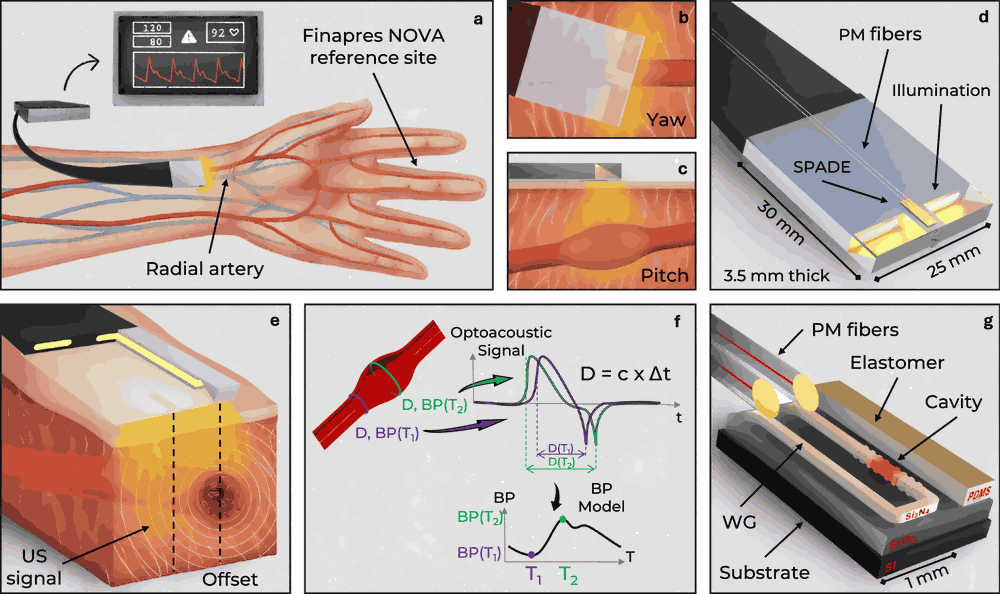
a. A wearable optoacoustic sensor targeting the radial artery close to the wrist. The sensor is connected to a console that reads out the optoacoustic signals and converts them into the BP (blood pressure) waveforms. The results are compared to a reference system on the finger. b, c The sensor is positioned on the skin above the radial artery with an unknown yaw angle, which depends mainly on the placement, and an unknown pitch, which depends mostly on the vertical orientation of the artery itself. d The operational end of the sensor, showing the illumination pattern and the SPADE (silicon photonics acoustic detector), which is coupled with two PM (polarization-maintaining) optical fibers. e The optoacoustic sensing procedure involves an excitation light from the sensor that diffuses in the tissue and induces outward-propagating US (ultrasound) waves inside the artery that reach the SPADE. f During each cardiac cycle, a pressure pulse travels down the arterial tree, altering the arterial diameter. The optoacoustic signal is used to directly measure the arterial diameter, and a physiological algorithm is used to convert it to a BP value. g The structure of the SPADE is shown, where the pressure-sensitive volume is the section of the WG (waveguide) marked in red.
Nature Communications volume 17, Article number: 10931 (2026)
Gil Gelbert, Ron Moisseev, Yoav Hazan, Tamar Harary, Daniel H. Lange & Amir Rosenthal